
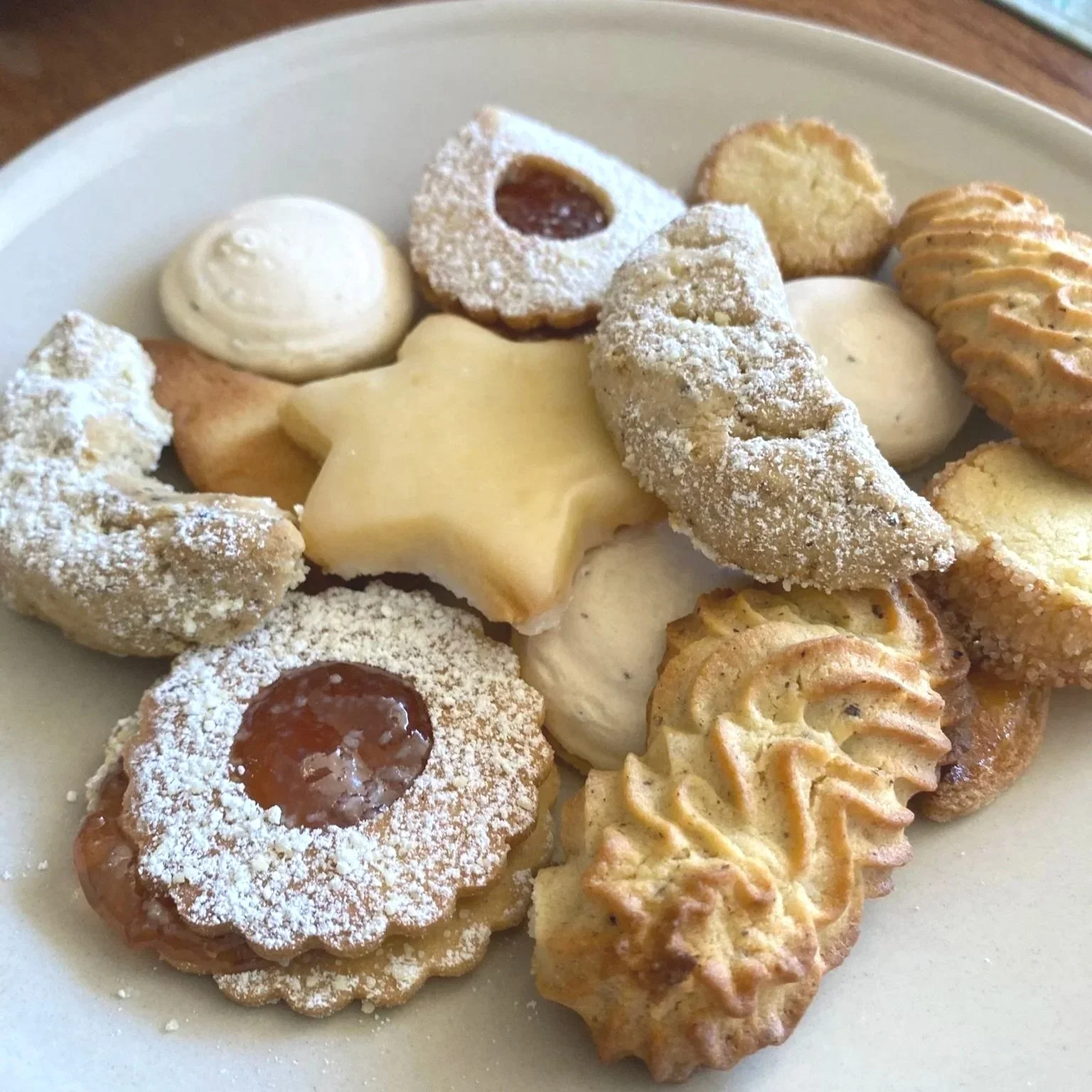
The Story of Alsatian Bredele
and Spitzbuebe
In Alsace, Christmas doesn’t truly begin until the scent of freshly baked bredele fills the kitchen. These small traditional biscuits, whose name comes from the Alsatian word meaning “little breads, have been baked for centuries and are an essential part of the region’s Advent traditions.
From late November, families gather to prepare many varieties of bredele: buttery, spiced, nutty, or delicately scented with citrus. Baking them is more than a culinary ritual—it is a moment of sharing, passed down from one generation to the next, often using handwritten recipes and well-worn cookie cutters.
Among the most beloved of all bredele is the Spitzbuebe, also known as Linzer-style biscuits. These delicate butter cookies are cut with a small window in the centre, then filled with raspberry or redcurrant jam. Their name, which loosely translates to “little rascals,” is said to come from their playful appearance—tempting, irresistible, and always disappearing far too quickly from the biscuit tin.
Traditionally, Spitzbuebe are assembled in December and dusted with icing sugar, ready to be shared with family, neighbours, and unexpected visitors during the festive season. In Alsace, offering a plate of bredele with a cup of coffee or mulled wine is a gesture of warmth, hospitality, and celebration.
Even today, these biscuits remain a symbol of Alsatian Christmas—simple, generous, and deeply rooted in tradition. One bite is enough to bring back childhood memories, winter evenings, and the magic of Christmas in Alsace.
Ingredients (makes about 25–30 biscuits)
100 g unsalted butter, softened
125 g icing sugar
1 egg
1 tsp vanilla extract
Zest of ½ lemon (optional but traditional)
250 g plain flour
1 pinch of salt
Raspberry or redcurrant jam (traditionally used)
Extra icing sugar, for dusting
👩🍳 Method
Prepare the dough
In a large bowl, cream the butter and icing sugar until light and smooth. Add the egg, vanilla, lemon zest, and salt, and mix well. Gradually add the flour and gently combine until a soft, smooth dough forms.
Do not overwork the dough.
Chill
Shape the dough into a flat disc, wrap in cling film, and refrigerate for at least 1 hour. This helps the dough firm up and keeps the biscuits delicate.
Roll and cut
Preheat the oven to 170°C (fan 160°C).
Roll the chilled dough on a lightly floured surface to about 3 mm thickness. Cut out shapes (round or flower shapes are traditional). For half of the biscuits, cut a small hole in the centre using a small cutter.
Bake
Place biscuits on a baking tray lined with parchment paper.
Bake for 10–12 minutes, until lightly golden around the edges.
Allow to cool completely on a wire rack.
Assemble
Spread a thin layer of jam on the flat (whole) biscuits. Dust the biscuits with holes generously with icing sugar. Carefully sandwich them together.
Rest before serving
Store the assembled Spitzbuebe in an airtight tin for 24 hours before serving. This resting time allows the flavours to meld and the texture to soften slightly—just like in Alsace.
✨ Tips from Alsace
Raspberry jam gives the most traditional tart flavour.
Spitzbuebe keep well for up to 2 weeks in a cool place.
Many families bake several bredele varieties at once and store them together in metal tins.

🎄 Merry Christmas and warm wishes for the New Year ✨🎁
Francois